I went to see the movie Wonder Woman last week. For the second time.
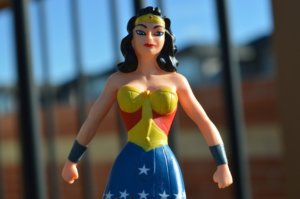
Wonder woman action figure
There were many things I like and appreciate about the movie:
- Female superhero: check
- Strong female lead character: check
- Female lead who doesn’t spend time obsessing over a guy: check
I’m also glad Gal Gadot is Israeli, to remind us there are talented actors all over the world – and who can appeal to a wide audience. And I liked that the women in the opening scenes were strong and powerful as well.
But since “seeing more” is what I’m about, here are a few thoughts about what I didn’t like so much.
The lesser wonders of Wonder Woman have to do with the ways it upholds, plays to, and further engrains certain stereotypes. Here are a few that stand out for me (and for the folks I saw the movie with). If there are others you have found, please add them in the comments.
Stereotype 1:
First, the movie opens with a young Diana running and doing her own thing as her caregiver shouts for her to wait. And who is that caregiver? A Black woman. Sigh. It’s the opening scene.
Yes, these are strong Amazon women. Yes, it’s great that there are Black women represented (and there are also a few who are in the fighting sequences and at least one who has a high enough position to speak to the queen). But…
Stereotypes 2-5:
Then of course, Steve Trevor, the man who saves the day is a White American. I’ll leave it at that.
While Steve’s team members are a diverse bunch (applause here), their portrayal leaves a lot to be desired in how they reinforce stereotypes. His team members include;
- Charlie: a Scottish man who is a drunk (yes, he is a great marksman, but he drinks. A lot.).
- Sameer: a Brown man (his fez suggests he may be Moroccan). Yes, it’s true that he had a great line about wanting to be an actor and not being the right colour. Nicely done! But he is one of a handful of people of colour in this movie. I saw one Black soldier. Remember there were Black (and First Nations/Native American) soldiers fighting in WWII. Albeit in segregated regiments. Too bad this movie had to reinforce their erasure, rather than use it as an opportunity to shine a light on their service.
- And a First Nations person named…Chief!
While these may seem innocent to you, consider that whenever we use stereotypes, we make it harder for the people that fit these descriptions to rise above them in the eyes of others. Why? Because it’s another silent confirmation that these faulty and one-dimensional portrayals of people are true – due to the fact when we see or hear something consistently, it becomes the bias our brain goes to, unconsciously. Ack!!
Stereotypes and First Nations / Native American people:
I have to spend some time on Chief, since there were a few things that particularly irritated me in relation to this character.
First, Wonder Woman speaks hundreds of languages – some of which she demonstrates in the film. But when she meets Chief, she clearly understands what he is saying, but she responds in English. Another missed opportunity in my opinion – and a subtext that delegitimizes the language.
Then, when the team breaks up, and Steve tells the guys to let them know where they are, Chief accomplishes this with…ready?…. smoke signals. Smoke signals! So, here is the thing about smoke signals. It’s not that they are culturally inaccurate. Smoke signals were used by many peoples around the world as a method of communication – Native American Tribes and First Nations among them. But smoke signals were complex: they communicated messages, they didn’t simply indicate a location!! So my problem with these is the way they are portrayed, and the way they are stripped of meaning and complexity – another opportunity lost.
Eugene Brave Rock – who plays Chief – is a Canadian actor who I heard interviewed on CBC earlier this summer. He is from the Blood Tribe in Southern Alberta. He mentioned how pleased he was to have been given so much control over his character – in an industry that still portrays First Nations people and Native Americans in the ways others see them. He used his native Blackfoot language for his character in the movie. That gives me a little hope. And I’m sure those who speak Blackfoot appreciate that contribution. And Chief does have a great line (like Sameer) about how Steve’s people killed off most of his people. But calling him “Chief”? Using smoke signals in a way that diminishes their value? Really?
You can read his CBC interview here.
What movies could do:
It saddens me that in 2017, Eugene Brave Rock should still be so thankful for the opportunity to provide input to make the character he portrays more authentic. That is just a shame. Why are we, as minorities, so happy with (still) so little? And what is the impact of that on who and what is portrayed on the screen – and on the millions of people watching?
This movie was about entertainment.
However in any movie, there exists a platform that can either reinforce or challenge (un)conscious bias and stereotypes. Movies could give us something more to think about. Even the ones that are purely for entertainment, not education. They could challenge us to see more and think broader instead of reinforcing the stereotypes and roles that have been assigned to some people (and so consistently we may not recognize them as stereotypes anymore).
I think Wonder Woman could have done more…
See more.